
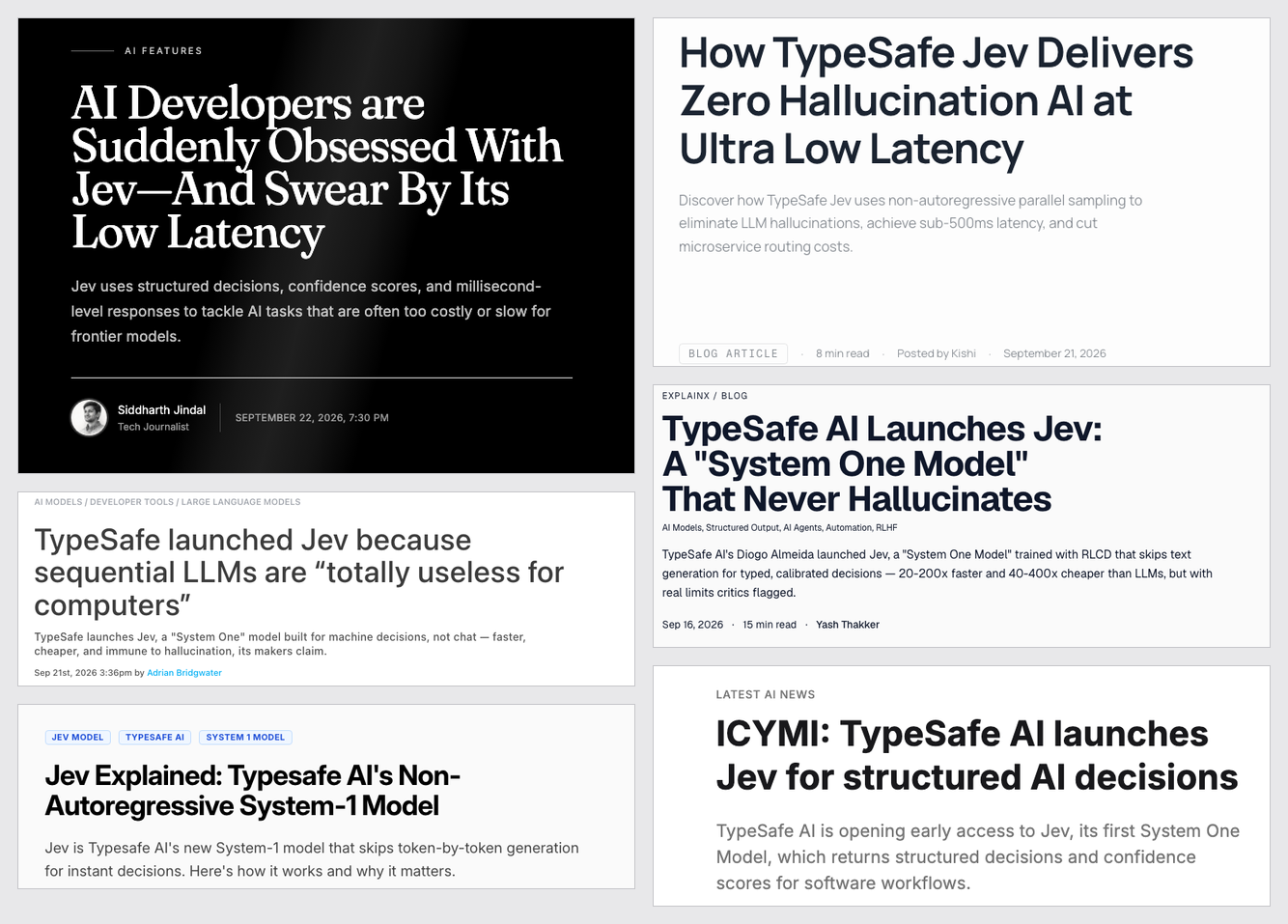
There's a lot of excitement about Jev, a new hosted model by TypeSafe (at least if you believe the flurry of headlines talking about it). It takes a piece of text and a fixed question and hands back an answer with a probability. The questions come in three shapes: yes or no, pick one of these, or rate this on a scale. In machine learning terms: binary classification, multiclass classification and ordinal regression.
But I think people are getting excited about this too prematurely. People are getting excited about the idea that "hey, maybe LLMs are not the only way to do AI?" But while they're re-discovering machine learning, they're also re-discovering a basic principle of machine learning: the no free lunch theorem.
Every model is built with assumptions about what its problem looks like, and those assumptions are the only reason it's ever right about anything. The no free lunch theorem says there is no set of assumptions that works everywhere: whatever makes a model good at your problem is what makes it bad on somebody else's.
So the important question is: how do we know it's not just outputting inaccurate, but confident garbage?
What their own documentation says
I read their documentation, all 903,311 characters of it across 110 pages. To their credit, they're candid about where the model fails, but there's no good measurement of its accuracy. The one head-to-head they publish puts their own model behind three language models on consistency, on a page that says four separate times that it does not measure accuracy.
Here are those numbers, because they're the most useful thing in the docs. Their consistency cookbook asks the same question fifteen times and counts how often the answer comes back the same. Raw label agreement: Jev 90.8%, against claude-haiku-4-5 at temperature 0 on 100%, gpt-5.4-mini at temperature 0 on 99.2%, and claude-opus-4-8 on 92.5%. Jev only reaches 99.2% after it declines to answer 25.8% of the time.
Their own page is careful about what that shows, and one of the sentences is simply "None of this shows accuracy or superiority." They're right: consistency isn't accuracy. A model can be perfectly consistent and yet consistently wrong at the same time.
Furthermore, there are some omissions that I think are quite striking. Across the whole corpus there's no accuracy figure against any external reference, no model card, no system card, no technical report, and no statement of training data, model size, parameter count or architecture. The SDK's ModelCard type carries three string fields: name, description and release date.
Something to pay attention to here, though. They state the calibration caveat themselves, that it "is measured across groups of predictions; it does not guarantee that an individual answer is correct." They tell you to validate on your own data in at least three separate places. Their skill-suggestion cookbook admits its benchmark requests were written by Claude Sonnet 5 and are "easier than the ones users send", and that the feature fixed 37 of 315 requests while breaking 7 the agent had right on its own.
What the independent studies measured
Two university teams did measure it. The bigger study, a preprint by Hazem Ibrahim and Yasir Zaki, ran 18 classification tasks against 19 language models and lost to the best one on 14 of the 15 scored tasks, at 44 times lower cost. That's a reasonable tradeoff that some might make. But on one of them it was at least 0.9 confident on 78% of the items, and it got 62% of those wrong.
Both studies are preprints from last week, run against one version of the model, and their authors say audits of commercial systems should be treated as perishable. Take that seriously about this article too. The numbers here describe Jev 1.13 in September 2026 and nothing else.
The takeaway here is that you should consider systems like Jev as parts of LLM-led processes, possibly as tool calls. But it's not general-purpose: if you want reliable results, you make measurements of a fixed system on your own problem, which is what AI experts (by which I mean those who studied more than just ChatGPT / Claude) were already doing anyway.
Always remember this, whether it's with Jev or any other tool that gets media hype: the only measurement that tells you whether a model works on your problem is the one you run on your problem.
Some questions
What is Jev?
A hosted classification model from TypeSafe, launched in September 2026. You give it a piece of text and a fixed question, and it returns an answer with a confidence score. That allows you to rank the possible responses.
Is Jev more accurate than a large language model?
On the published evidence, no. In Ibrahim and Zaki's study it lost to the best language model on 14 of the 15 scored tasks. TypeSafe publishes no accuracy comparison of its own, and its one head-to-head measures consistency rather than accuracy.
Is it cheaper?
Yes, substantially. The same study measured a median 44 times lower cost, with all 18 tasks costing $0.21 on Jev against a range of $0.34 to $62.99 across the 19 language models. That's a real trade-off and some teams will take it.
Does a confidence score mean the answer is probably right?
Not on its own. Calibration is a property of a group of predictions rather than a guarantee about any single answer, and TypeSafe says so in its own documentation. On the empathy classification task in the study, Jev was at least 0.9 confident on 78% of items and wrong on 62% of those.
What is the no free lunch theorem?
Informally: averaged over all possible problems, no learning algorithm beats any other. Every model encodes assumptions about what its problem looks like, and those assumptions are the only reason it is ever right. There is no set of assumptions that works everywhere, so whatever makes a model good at your problem is what makes it bad on somebody else's.
So should I use it?
It's worth considering as a component inside an LLM-led process, possibly as a tool call, and it isn't a general-purpose classifier. Nobody has measured it used that way, since every published study runs it standalone and zero-shot. What is measured so far is that it lost to the best language model on 14 of the 15 scored tasks and cost a median 44 times less. Either way, measure it on your own data first, which is what TypeSafe's own documentation tells you to do in three separate places.