
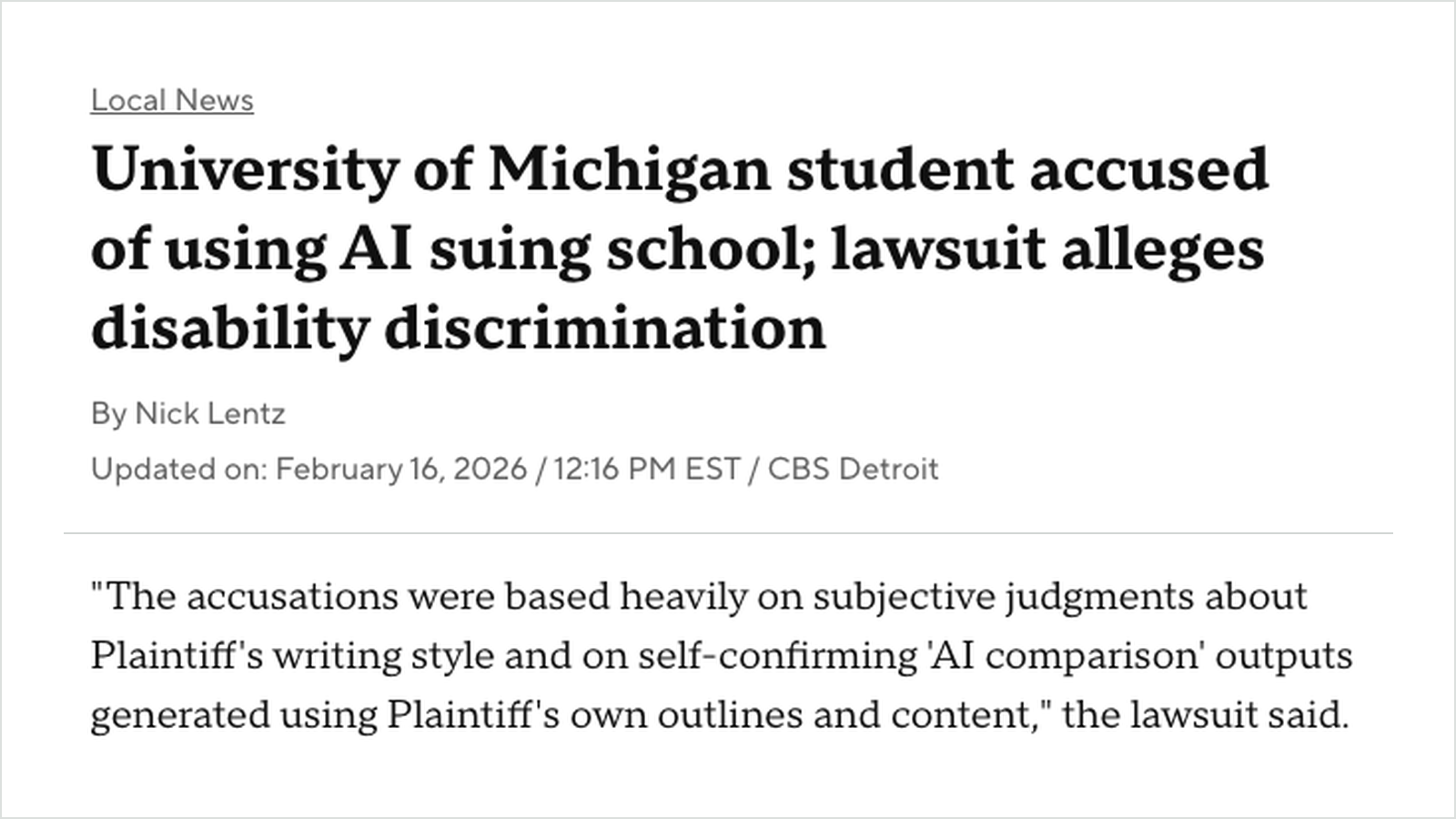
I use AI models every day, and I've written before about how strange their writing got. The other side of that is that readers are now on high alert for it, and they can't actually tell the difference. They guess from how a piece sounds, and when they guess wrong, the person who really wrote it pays. In one experiment, human-written headlines labeled as AI lost just as much credibility as headlines an AI really wrote. And a University of Michigan student is suing the school after being accused of using AI on papers the student says they wrote themselves.
Nobody should have to prove they wrote their own work. But until that changes, it's worth knowing what sets readers off, and the research is pretty consistent about it. It comes down to six habits: put yourself in it, say what you think, cut the generic lines, write the way you talk, skip the cheerful summary and drop words like "delve." Typos, deleting em dashes and humanizers won't save you.
What to do if your writing sounds like AI
1. Put yourself in it
In a 2026 study by Litvinova and Dekhnich, professional linguists judged short texts written by people and by AI, and what tracked their verdicts wasn't who actually wrote each one. It was whether they could picture a real author: "Readers were less likely to label a text as AI-generated when they could picture an author who believes in what they're saying." So put in what you actually saw or did, with the kind of detail only someone who was there would know.
Instead of: "Effective onboarding is essential to new employee success."
Try: "All three of our last hires asked me where the VPN password was in their first week, so now it's on page one."
2. Say what you think
In that same study, signs of the author's own belief and emotion made readers less likely to call a text AI. And casual readers tend to call anything in a neutral tone AI, so a careful both-sides paragraph is exactly what gets flagged. Take a position and say why.
Instead of: "Remote work has both advantages and disadvantages, and the right approach depends on your team."
Try: "I'd put most teams in the office two days a week, because every time we've gone fully remote, new people stop asking questions."
3. Cut anything that could sit in anyone's document
The texts that got called AI in the Litvinova study were the ones that felt general, obvious and template-like. A quick test is to imagine someone else's name on the paragraph. If it would read exactly the same, rewrite it with something specific or delete it.
Instead of: "In today's fast-paced world, clear communication is more important than ever."
Try: Delete it, and start with your second sentence.
4. Write the way you talk
Readers take first-person pronouns and contractions as signs of a human. Those cues don't prove anything about who wrote a text, but they're what readers go on.
Instead of: "It has been determined that the deadline cannot be met."
Try: "We're not going to make the deadline."
5. Don't end with a cheerful summary
When experienced readers explained why they flagged a text, "cheerful summary conclusions" and formulaic structure kept coming up. End on your last real point. It doesn't need a bow on it.
Instead of: "In conclusion, by focusing on these key areas, we can build a brighter future for our customers."
Try: "The pilot starts next month, and by spring we'll know whether it actually cut wait times."
6. Drop the words that sound like AI
Do this one last. It's what experienced readers notice first, but swapping words won't give anyone an author to picture. The AI words to avoid are the ones those readers kept pointing to, like "delve," "crucial" and "testament," and they sometimes flagged real people who happened to use them, so cut them even when they're genuinely yours. I wrote a free skill, Plain English, that audits a draft for these words (and for old-fashioned bloat) and only rewrites when you ask. In Claude Code, install it with /plugin install plain-english-house@licato and run /plain-english-house audit on your draft, or get it for other agents at actualization.ai/skills.
Instead of: "Let's delve into why this is a crucial step."
Try: "Here's why this step matters."
What doesn't work?
Adding mistakes. Readers are actually more likely to call a text AI when it has grammar errors, and clean writing pays. In one field experiment, job seekers who got help polishing their resume writing were hired 8% more often.
Deleting your em dashes. Wikipedia's editors now list em dash overuse as a historical indicator that's much less frequent in newer models, so it's a fading signal.
Running it through a humanizer. In that study of experienced readers, they still caught every AI article that had been humanized. And Turnitin now has a feature that flags humanizer use, so an honest writer can end up looking like they had something to hide. Don't use one.
If you want more findings like this, subscribe to Dr. Licato's AI Field Notes. It's where I share what I'm learning about making AI agents actually work, along with the free skills as I build them.