
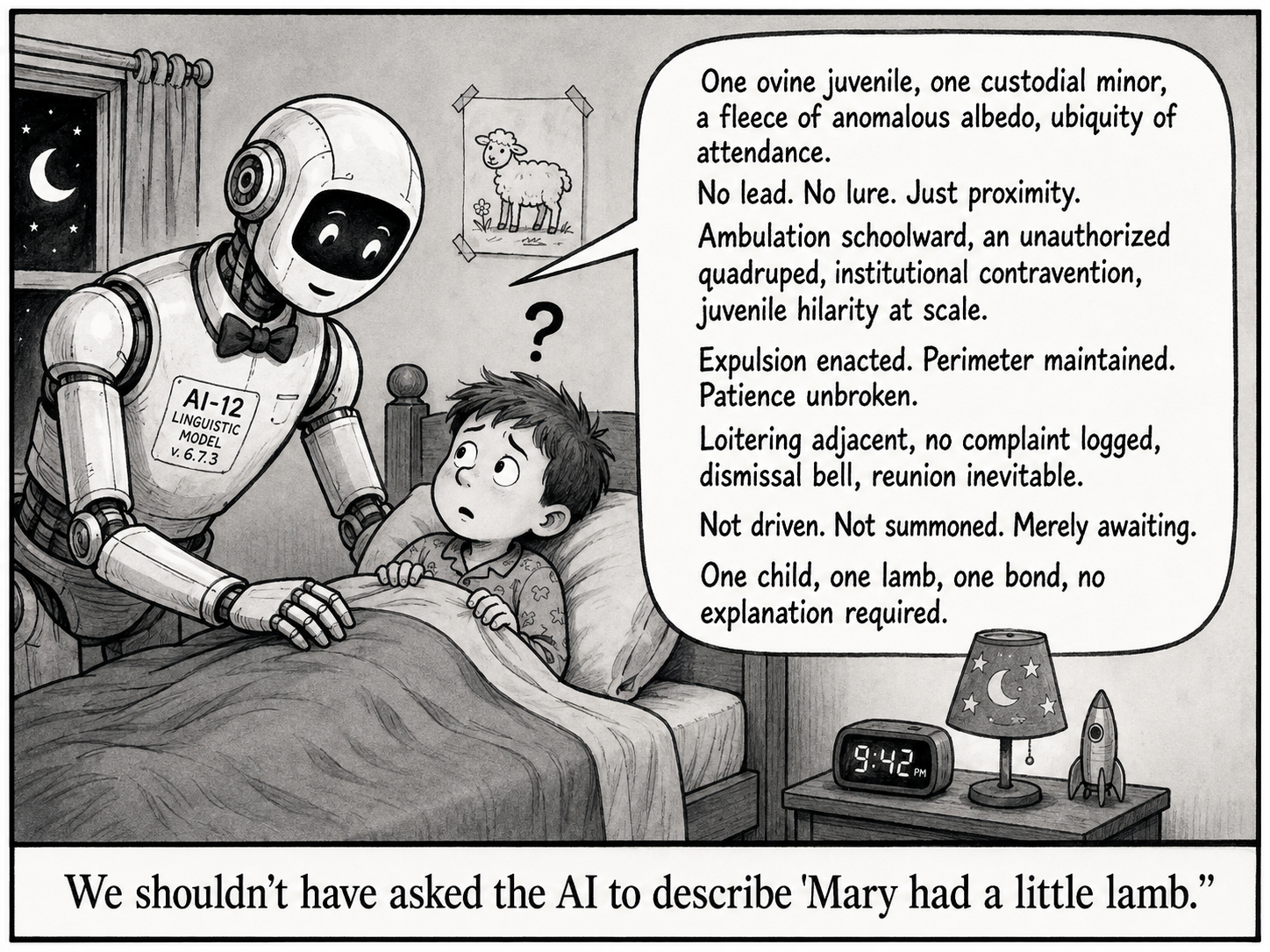
Somewhere in the last year, the AI models I use every day started writing in a way I could barely read.
Not wrong. Not incoherent. Just strange, in a specific and consistent way. I would ask a straightforward question and get back something that read like the executive summary of a report nobody had written yet. Short bursts. Nouns stacked on nouns. A rhythm that sounded confident and told me almost nothing.
Here is the kind of sentence I mean:
86 editing jobs, four Word add-ins, the same instruction to each, six binary checks per run.
Read that again and notice how much work you are doing. It contains four facts that play four different roles. The 86 is a sample size. The four add-ins are the things being tested. The identical instruction is a control. The six checks are how the results were judged. The sentence flattens all of that into a list and leaves you to sort out which is which.
I started noticing it everywhere. In plans. In summaries. In answers to questions where I just wanted a yes.
Am I the only one who noticed this?
No, and it is not close.
In July 2026, someone posted to r/ClaudeAI that Claude's invented jargon and dense compound words were driving them insane. That post now sits at 740 points with 385 comments. The subreddit's moderation bot generated an automatic summary after 320 of them, and it opens by telling the poster, in effect, that they are not crazy and the consensus is a resounding yes.
The same summary lists what it calls a jargon hall of shame, with "load-bearing" as the undisputed champion, alongside blast radius, footgun, yak shaving, belt-and-suspenders, and substrate. It also records the honest counterpoint, which I want to keep rather than bury: several actual software engineers pointed out that many of those terms are ordinary industry vocabulary. The complaint is not that the words are invented. It is that they arrive constantly, at full density, whether you are designing a distributed system or a to-do list.
Over in r/ClaudeCode, a separate thread asks about Opus 5 and its convoluted answers. The top comment is from someone who has taught English at university level for years and is finishing a PhD written in English. They say they told the model outright that they could not understand it.
That one stayed with me. If a person who reads and writes English professionally cannot follow the output, the problem is not the reader.
So what is this style actually called?
I did the obvious thing and asked an AI to name the pattern in its own writing. ChatGPT came back with a term I have not been able to stop using since: asyndetic parataxis.
The two halves are old rhetorical vocabulary. Asyndeton means leaving out the conjunctions. Parataxis means placing clauses side by side as equals rather than subordinating one to another. Put together, they describe writing that strips out the connecting words and lines everything up as though it carries the same weight.
That is exactly what the 86-editing-jobs sentence does.
What makes a sentence asyndetic parataxis?
Three features, and they usually travel together.
Artificial parallelism. Every piece gets roughly the same grammatical weight even though the pieces are not conceptually equivalent. A sample size, a treatment set, a control, and an evaluation method become four items in a row. Ordinary prose would encode those relationships syntactically, using words that tell you which is which.
A numerical drumbeat. 86, then four, then the same, then six. The cadence belongs to an executive summary slide or a piece of ad copy. It is built to make a methodology feel concrete rather than to explain it, and those are different goals.
Suppressed connective tissue. The words that would carry the logic go missing. Using. Across. For each. And then. With. Whole clauses disappear, including the ones that would tell you what was actually done, like "we evaluated each result using." Parataxis characteristically leaves the reader to infer relationships that hypotactic syntax would have spelled out.
That last one is the heart of it. The style does not remove information so much as remove the instructions for assembling it.
Has anyone else described this?
Yes, and by a different route, which is why I trust it more.
In July 2025, the linguist Colin Gorrie wrote a piece called "Why ChatGPT writes like that" at the Dead Language Society. He identifies what he calls compulsive parallelism, which he describes as using the same kind of word, phrase, clause, or sentence in a row. His example is that a model will rarely tell you something is efficient without adding that it is also reliable and effective.
Gorrie does not use the words asyndeton or parataxis anywhere in that article. His vocabulary is parallelism, antithesis, and the ascending tricolon, and he traces those devices back through classical rhetoric. So two independent descriptions, one from a linguist working in the rhetorical tradition and one from a language model asked to diagnose itself, land on the same underlying behavior from opposite directions. That convergence is the interesting part.
His framing and mine differ in emphasis. He is describing a model that cannot stop building balanced sets of three. I am describing a model that has deleted the grammar holding a sentence's logic together. They are two symptoms of the same habit: reaching for rhythm where meaning should go.
How do I stop Claude writing like this?
Put the following in your CLAUDE.md file, your system prompt, or whatever instruction set your tool of choice uses. I wrote it to be specific enough that a model can actually check its own output against it, which is the part most style instructions get wrong. "Write clearly" is not an instruction a model can act on. A list of identifiable features is.
This matters beyond taste. When a model is drafting into a document that someone will sign, review, or file, a sentence that hides its own logic is a defect rather than a style choice. It is one of the reasons we built SquarePact around what AI output does once it lands in a real document rather than in a chat window.
If you would rather install this than paste it, the same rules are packaged as a free skill called Sentence Logic Check, which detects the pattern and rewrites it rather than only telling a model to avoid it. It installs into Claude, ChatGPT, Cursor and the other agents listed there.
DO NOT WRITE USING ASYNDETIC PARATAXIS
Avoid prose that compresses multiple facts, conditions, or relationships into a rhythmic sequence of parallel noun phrases or sentence fragments.
This style often looks like:
86 editing jobs, four Word add-ins, the same instruction to each, six binary checks per run.
It can sound polished or emphatic, but it often feels artificial because it replaces normal grammatical relationships with cadence.
How to identify it
Flag a sentence or passage when several of these features appear together:
- A sequence of noun phrases with no main verb.
- “Three teams, two weeks, one goal.”
- “No setup, no configuration, immediate results.”
- Several facts are presented as grammatically equivalent even though they play different logical roles.
- A sample size, method, constraint, and evaluation criterion should not automatically become four parallel list items.
- Numbers create a conspicuous rhythmic pattern.
- “12 markets, 4 models, 3 scenarios, one conclusion.”
- Connective language has been removed for punchiness.
- Missing words often include using, across, for each, because, while, with, so that, after, and which.
- The prose resembles a presentation slide, slogan, headline, or marketing tagline rather than ordinary explanatory writing.
- A sentence could be converted into several complete clauses simply by restoring the relationships between its parts.
- Parallelism is being used by default rather than for a specific rhetorical reason.
Also watch for the closely related pattern of staccato fragments used for artificial emphasis:
No configuration. No delays. No compromises.
And for repetitive contrast formulas such as:
Not X. Not Y. Just Z.
These devices are not forbidden, but they should be uncommon and intentional.
How to rewrite it
Prefer complete sentences with explicit grammatical relationships.
Instead of:
86 editing jobs, four Word add-ins, the same instruction to each, six binary checks per run.
Write:
We ran 86 editing jobs across four Word add-ins. Each add-in received the same instruction, and we evaluated every result using six predetermined binary checks.
Instead of:
Three models, two datasets, one clear winner.
Write:
We tested three models on two datasets, and one model performed clearly better than the others.
Instead of:
No plugins. No setup. Just open the file and start.
Write:
You do not need to install plugins or configure anything before opening the file and starting work.
General rule
Do not turn ordinary explanatory prose into a rhythmic inventory merely because the items can be made grammatically parallel.
Preserve logical hierarchy. Make clear which facts describe:
- what was done;
- what it was done to;
- how it was done;
- under what conditions;
- why it was done;
- and how the result was evaluated.
Prefer verbs, clauses, conjunctions, and prepositions when they clarify those relationships.
Do not remove connective tissue merely to make a sentence shorter or punchier.
Does this actually work?
In my own use, yes, and the reason is that the instruction is checkable. A model can look at a sentence and ask whether it has a main verb, whether the numbers are forming a pattern, whether the connecting words are missing. It cannot do anything useful with "write more clearly."
The community arrived at something similar by trial and error. That same r/ClaudeAI thread reports that output styles tend to stick better than instructions in a CLAUDE.md file, apparently because they are injected earlier in the conversation. If you have somewhere earlier to put this, put it there.