
No, last week's outages (Microsoft, Airports, Atlassian) weren't a coordinated cyberattack. But they weren't mere coincidence either.
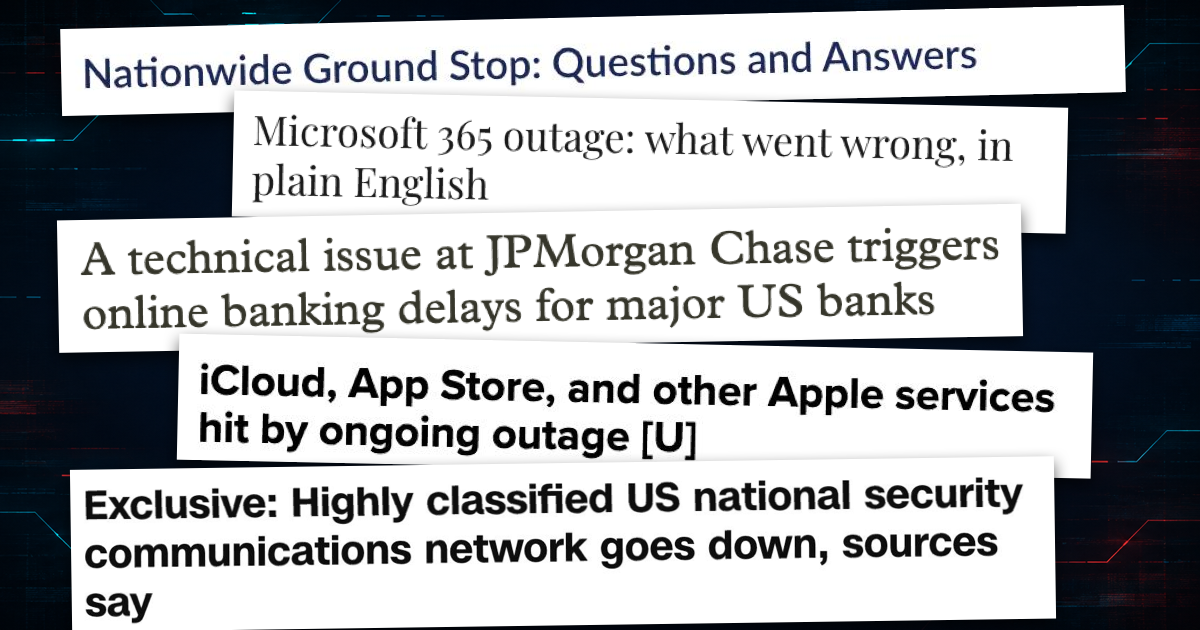
In case you missed it: the FAA grounded flights nationwide (Nov. 13), Microsoft 365 went down for about a day (Nov. 12 to 13), Chase's online banking stalled (Nov. 16), iCloud signed people out (Nov. 17), and even the NSA's internal network went dark (Nov. 17). I've said publicly that I'm skeptical of the official explanations that we were given, and my position hasn't changed. After all, the DNI, the DHS secretary and the FBI's deputy director all told Congress there's no evidence that cyberattacks had anything to do with it. The DNI also testified that the outages were "unrelated" to each other.
Each one of these things had its own individual cause. But looking at that causes in isolation isn't satisfying---it just doesn't explain why they all landed in the same week (and why it seems like it's still happening). So I dug in a bit further to make sense of it all, and here's what I think.
First, a reminder: AI is very much speeding up three things at once: writing code, finding bugs, and fixing them.
But hold on, please don't read that as "AI caused it" and make that your takeaway; it's much more nuanced than that. I don't mean an AI went rogue and broke anything. Each of those three speedups can be a good thing on their own, but taken together they all lead to these things:
- More changes being deployed to live systems.
- More bugs and vulnerabilities being found faster than ever, even in systems that have been "secure" (or so we thought) for more than a decade.
- Pressure to create and deploy patches quickly, because of panic that someone else armed with an AI bug-finder will exploit those vulnerabilities (Fortune describes teams "racing to patch before bad actors can exploit them with equally powerful AI tools").
Let's look at these one at a time. Google says 75% of its new code is now AI-generated. Microsoft's October update fixed a record 1,413 vulnerabilities, and as Dustin Childs of the Zero Day Initiative put it: AI "isn't creating these bugs out of thin air; it's just shortening the time between a vulnerability existing and someone noticing it." And Google now runs AI agents that find and fix critical flaws. Google said last year that a human reviews every one of those patches before it goes out, but its April update doesn't say whether that still holds now that the volume is growing.
So it's the combination of these things. All of those affecting all software at the same time, and you get exactly what the DNI described to Congress: "the rate of patching, the rate of upgrading of systems, is increasing." Sen. Mark Warner described companies patching "often all at once, putting tremendous strain on systems that weren't built to handle that pace of change."
The NSA is the clearest case of this happening. Its systems failed to come back up after patching flaws that researchers had found the month before, using an AI-assisted audit.
Now, my explanation has a huge asterisk next to it. Not every outage directly traces back to AI. And many of these organizations are outright denying the link to AI: Microsoft says its outage was "not related to cyber or AI/agents", and Chase says it didn't find or fix its bug with AI. The FAA says its trouble started while a contractor was installing a new router. And I don't know whether any of these outages came from AI-written code, because nobody has given us transparent evidence of it. But nearly every one of them started with a change somebody made to their own system, which is exactly the kind of risk that grows when everything speeds up...and the timing of all of this is just too convenient.
So here's what this means for you, and what you should do:
- It may get worse before it gets better. Rep. Jim Himes said the faster pace of patching "could cause more frequent outages." If you run a business, the same goes for every vendor you depend on. Microsoft 365 was down for about a full day, and a lot of organizations were stuck not being able to communicate (though MS Teams seems to have been mostly unaffected). Does your organization have a backup communication plan?
- Don't ship every patch at once. This really already is standard best practice for software engineers, but it's worth a reminder. Stagger fixes, and roll each one out to a small slice of your systems before the rest.
- Test on machines that actually look like real production environments. Microsoft's load tests missed the bug because they ran on weaker hardware than the servers that failed.
- Make sure you can undo an old change, not just yesterday's. Microsoft's rollback tools couldn't revert a change from July, so it had to write a new update to undo it.
- If you have a software system, and you're not already using the best AI possible to find bugs and vulnerabilities, do it now or someone else will.
I want to reiterate: this isn't an argument for slowing down how fast we find and fix bugs. Cliff Steinhauer of the National Cybersecurity Alliance compared it to closing a cracked bridge for repairs, which is disruptive but a lot better than letting the bridge collapse.
These are growing pains. Things will calm down when we find a new balance, but things may get worse before they get better.
If you want more findings like this, subscribe to Dr. Licato's AI Field Notes. It's where I share what I'm learning about making AI agents actually work, along with the free skills as I build them.